Running a fence company is more than just installing fences. It's managing leads, writing estimates, scheduling crews, ordering materials, collecting payments, and keeping customers happy — all while trying to actually install fences.
Most fence contractors are great at the installation part. The business side? That's where things get messy.
This guide covers everything you need to run a fence business efficiently — and introduces free tools that make it easier.
The Complete Fence Business Toolkit
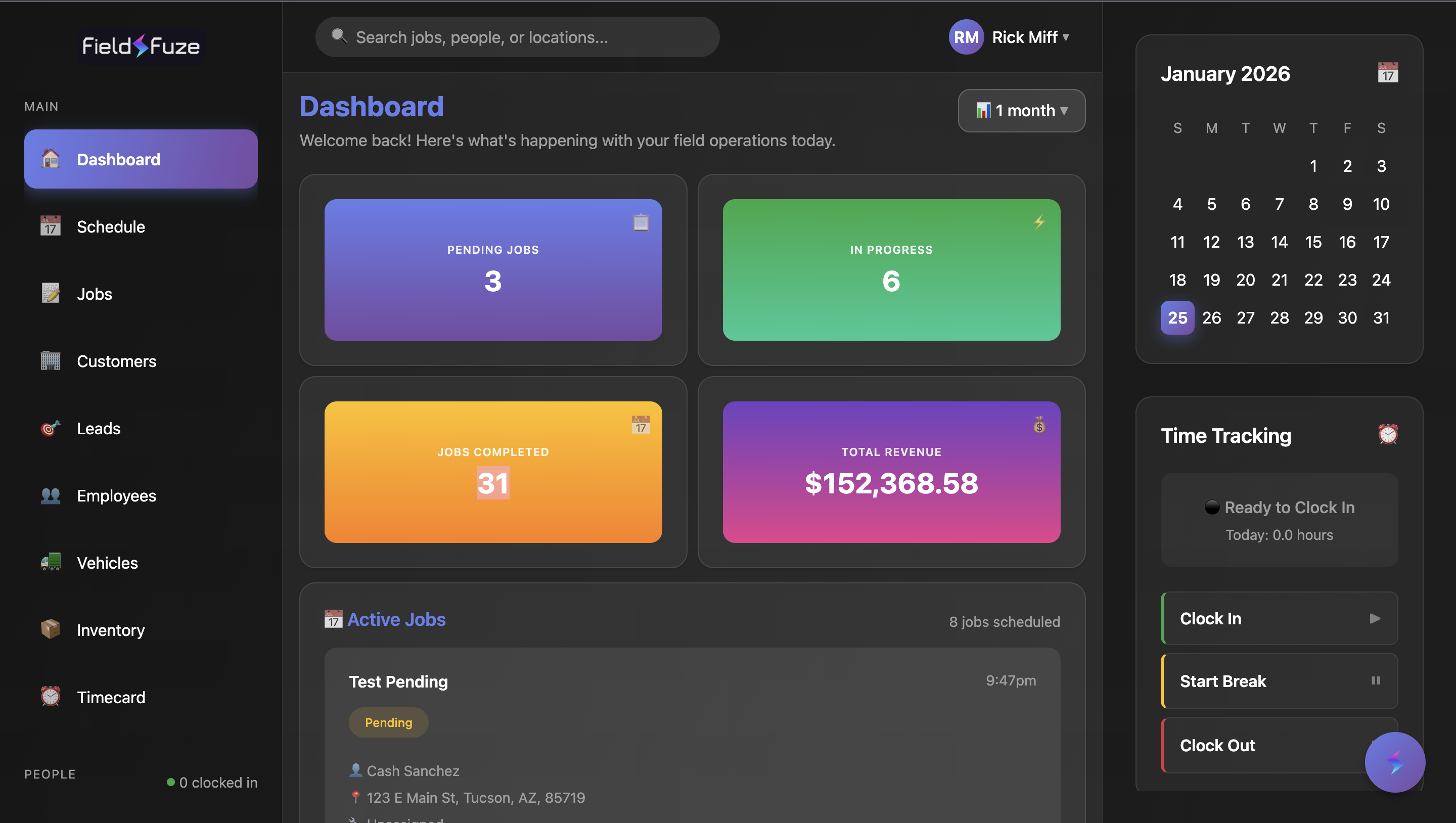
FieldFuze gives fence contractors everything they need:
$0/monthEstimates, scheduling, CRM, invoicing, payments, and crew management. One platform, no monthly fees.
The Five Pillars of a Profitable Fence Business
Every successful fence company masters these five areas:
- Lead Generation — Getting potential customers to call
- Estimating — Quoting jobs accurately and professionally
- Scheduling — Managing your calendar and crew efficiently
- Execution — Installing fences to quality standards
- Collections — Getting paid quickly and consistently
Let's break down each one.
Pillar 1: Lead Generation for Fence Contractors
You can't install fences without customers. Here's how successful fence companies generate leads:
Google Business Profile (Essential)
When someone searches "fence company near me," Google Business Profile determines who shows up. Optimize yours:
- Complete every field — hours, services, service area
- Add photos regularly — completed fences, your crew, your truck
- Respond to every review, positive or negative
- Post updates monthly — seasonal offers, project highlights
Customer Reviews (Most Important)
Reviews are the #1 factor in getting chosen over competitors. Ask every satisfied customer:
- Send a review request via text or email after job completion
- Make it easy — include a direct link to your Google review page
- Thank customers who leave reviews
- Aim for 50+ reviews with 4.5+ average rating
Yard Signs (Free Advertising)
A yard sign on a completed fence is free advertising to the entire neighborhood. Every job should include:
- Permission to place a sign during installation
- A professional sign with your name, phone, and website
- Removal after 1-2 weeks (or leave longer with permission)
Referrals (Highest Close Rate)
Referred leads close at 50%+ rates. Encourage referrals by:
- Asking satisfied customers who else might need a fence
- Offering a referral bonus ($50-$100 gift card)
- Following up with past customers annually
Pillar 2: Estimating Fence Jobs
Your estimate is your first impression. Make it professional.
What Every Fence Estimate Needs
Professional Estimate Components
- Company branding — Logo, contact info, license number
- Customer details — Name, address, phone, email
- Fence specs — Type, height, total linear feet, gates
- Itemized pricing — Materials, labor, permits if needed
- Terms — Payment schedule, warranty, timeline
- Photos — Site photos showing existing conditions
- Signature line — Space for customer approval
FieldFuze includes all of these features in its free estimate builder. Create professional quotes on your phone, get e-signatures, and convert to jobs with one click.
Pricing Your Fence Jobs
Know your numbers. For every job, calculate:
Fence Job Cost Breakdown
If your costs are $3,000, charge $4,300-$6,000 to hit these margins.
Following Up on Estimates
Most fence contractors lose jobs by not following up. Create a system:
- Same day — Send the estimate via email or text
- 24-48 hours — Call to answer questions
- 1 week — Follow up if no response
- 2 weeks — Final follow-up
FieldFuze tracks estimate status so you know exactly who needs follow-up.
Pillar 3: Scheduling Fence Jobs
Efficient scheduling maximizes revenue per day. Poor scheduling means wasted time, unhappy customers, and missed opportunities.
Scheduling Best Practices
- Group by location — Schedule nearby jobs on the same day
- Account for job size — Don't book a 300-foot fence followed by a 50-foot fence same day
- Build in buffer — Weather delays happen; don't overbook
- Match skills to jobs — Assign your best crew to complex installations
- Communicate early — Confirm with customers 24-48 hours before
Handling Weather Delays
You can't install fences in heavy rain. Plan for it:
- Never schedule 100% capacity — leave buffer days
- Have a rain day protocol — indoor work, material prep, estimates
- Communicate proactively — call customers before they call you
- Reschedule fairly — customers understand weather; they don't understand silence
Pillar 4: Crew Management
Your crew is your reputation. Manage them well.
Daily Crew Management
- Clear assignments — Every crew member knows where to be and what to do
- Job details available — Customer info, fence specs, access notes
- Materials confirmed — Everything needed is on the truck or at the site
- Time tracking — Know when crews clock in and out
Quality Control
- Require before/after photos on every job
- Do spot inspections on completed work
- Follow up with customers after completion
- Address quality issues immediately
FieldFuze helps with crew management through job assignments, time tracking, and photo documentation — all for free.
Manage Your Fence Business for Free
FieldFuze includes everything: estimates, scheduling, invoicing, CRM, and crew management.
Get Started FreePillar 5: Getting Paid
A job isn't profitable until you collect payment. Many fence contractors struggle here.
Payment Terms That Work
Standard fence payment structure:
- Deposit at signing — 25-50% of total (covers materials)
- Balance on completion — Collect before leaving the job site
For larger jobs ($10,000+), consider progress payments:
- 25% at signing
- 25% when materials arrive
- 25% at project midpoint
- 25% at completion
Make Payment Easy
The easier you make it to pay, the faster you get paid:
- Accept credit cards (customers expect this)
- Offer ACH/bank transfer (lower fees than cards)
- Send digital invoices with payment links
- Process deposits on the spot with mobile payments
FieldFuze includes payment processing (2.9% fee) — customers can pay invoices online instantly.
Handling Late Payments
- Invoice immediately — Day of completion, not a week later
- Reminder at 7 days — Friendly reminder email or text
- Call at 14 days — Personal call to understand the delay
- Final notice at 30 days — Written notice with late fee warning
- Collections at 60+ days — Consider collections or small claims
Growing Your Fence Business
Once you've mastered the basics, it's time to grow strategically.
When to Hire Your First Employee
Hire when you're consistently turning down work due to capacity. Signs you're ready:
- Backlog of 3-4+ weeks
- Losing quotes because timeline is too long
- Profitable at current workload
- Clear training process for new hires
Adding Fence Types
Expand your offerings strategically:
- Start with what you know — perfect your main fence type first
- Add related types — wood to vinyl, or chain link to ornamental
- Train before marketing — don't sell what you can't deliver
- Price for learning curve — first few jobs of a new type take longer
Expanding Service Area
Growing geographically requires careful planning:
- Factor in drive time — jobs 45+ minutes away eat into profit
- Price for distance — add travel charges for far jobs
- Group expansion area jobs — don't drive 1 hour for 1 small job
- Build local presence — Google Business Profile covers service areas
Common Fence Business Mistakes
Mistakes That Kill Fence Companies
- Underpricing — Racing to be cheapest leads to bankruptcy
- Not following up on estimates — Lost revenue from winnable jobs
- Poor cash flow management — Not collecting deposits, slow invoicing
- Overcommitting — Taking more work than you can handle
- Ignoring reviews — Letting negative reviews go unanswered
- No systems — Running everything from memory and paper notes
The Right Tools Make Everything Easier
You can run a fence business with paper and spreadsheets. But why make it harder than it needs to be?
FieldFuze gives fence contractors everything they need in one platform:
FieldFuze for Fence Contractors
- Estimates — Professional quotes with materials, labor, photos, e-signatures
- Scheduling — Calendar view, crew assignments, job details
- CRM — Customer info, job history, notes, documents
- Invoicing — Generate from jobs, track payments, send reminders
- Payments — Accept cards and ACH online (2.9% fee)
- Time tracking — Crew clock-in/out, overtime calculation
And it's free. $0/month, unlimited users, no contracts.
Fence Contractor Business FAQ
How do I run a successful fence contracting business?
Successful fence contractors focus on: accurate estimating, efficient scheduling, professional customer communication, timely invoicing, and consistent follow-up. Using software like FieldFuze ($0/month) helps manage all these areas from one platform.
What profit margin should fence contractors target?
Fence contractors typically target 30-50% gross profit margin. This means if materials and labor cost $3,000, you'd charge $4,300-$6,000. Your actual margin depends on local competition, job complexity, and efficiency.
How do I get more fence installation leads?
Top fence lead sources include: Google Business Profile optimization, yard signs on completed jobs, customer referrals, social media (especially before/after photos), and home service platforms. Focus on reviews — they're the #1 factor in getting chosen.
How do I schedule fence installation jobs efficiently?
Efficient fence job scheduling involves: grouping jobs by location, accounting for multi-day installations, building in weather buffer days, and matching crew skills to job requirements. Digital scheduling software shows your calendar at a glance and prevents double-booking.
How do I handle fence job deposits and payments?
Standard fence payment terms are: 25-50% deposit at signing, balance due on completion. For larger jobs, consider progress payments. Accept multiple payment methods (cards, checks, ACH) to make it easy for customers to pay.
What software do fence contractors need?
Fence contractors need software for: estimates, scheduling, invoicing, CRM, and payments. FieldFuze combines all of these for $0/month. You'll also need accounting software (QuickBooks, Wave) unless your fence software handles bookkeeping too.
Start Running a Better Fence Business Today
Running a fence company doesn't have to be chaotic. With the right systems and tools, you can:
- Win more jobs with professional estimates
- Schedule efficiently without double-booking
- Get paid faster with digital invoicing
- Keep customers happy with clear communication
- Grow profitably without burning out
FieldFuze helps with all of this — and costs $0/month.
Get Free Tools for Your Fence Business
Join fence contractors using FieldFuze to run more efficient, more profitable businesses.
Get Started Free — No Credit Card